Showing posts with label 1001 Books. Show all posts

Wednesday, 12 September 2012

Fear and Loathing in Las Vegas - Review


Title
: Fear and Loathing In Las Vegas
Author: Hunter S.Thompson
First Published: 1971
Genre: Humour, Journalism
Where to buy: Amazon, Waterstones, Book Depository

"I hate to advocate drugs, alcohol, violence, or insanity to anyone, but they've always worked for me". 
- Hunter S. Thompson


Fuck me they take a lot of drugs in this book don't they?

"...we had two bags of grass, seventy-five pellets of mescaline, five sheets of high-powered blotter acid, a saltshaker half-full of cocaine, and a whole galaxy of multi-colored uppers, downers, screamers, laughers... Also, a quart of tequila, a quart of rum, a case of beer, a pint of raw ether, and two dozen amyls. Not that we needed all that for the trip, but once you get into locked a serious drug collection, the tendency is to push it as far as you can. The only thing that really worried me was the ether. There is nothing in the world more helpless and irresponsible and depraved than a man in the depths of an ether binge, and I knew we'd get into that rotten stuff pretty soon."

If anything actually that's my main problem with this book. And don't get me wrong I'm a big pro-drug legalization supporter so I'm fine with them taking it, it's just that it seems to be the only real hinge to the book.

It's as if when Thompson was pitching this to the publisher he was like:

"Right, okay! So first there in a car...on drugs!
Then they go into a casino...on drugs!
Then they go back to there hotel room...still on drugs!
Then they have to go to a drug conference...on different drugs!
Then they go to an airport...on even more different drugs!"

It didn't seem to me like there was any other real backbone to the story. I just got the overwhelming feeling when I finished it of "Really? They get high all the time and then go on crazy hijinks in Las Vegas and then the book ends? Seriously? That was all there was too it?" There really wasn't much plot to get me particularly interested and didn't seem to go anywhere other than the enormous amounts of drug taking and booze drinking that went on in it.

But I wouldn't say the book was completely without merit. There are some great bits of social commentary in-between all the drug taking. Thompson provides despairing passages on the failure of the sixties dream throughout. I wasn't born in the sixties so I have no experience of what it was like, but for me there was a tinge of sadness in me knowing that all the positive sixties idealism shrivelled and died to make way for the harsh seventies. I've actually heard that the "swinging sixties" as everyone remembers it is a fairly romanticized version of the actual sixties. But even if that is so I still miss the ideals and attitudes that we now think of with that period. The idea that we could all do something to improve the world no matter how small. And that peace and love are the ultimate goals to strive for, in a world where people are free to be a member of any sex, race, religion, class or gender they want without prejudice and persecution. But now it's all gone. It crumpled and died like a flower that didn't get enough water.

If anything though I actually miss Hunter S. Thompson a little more than the sixties. Having read up on him more I learnt that he was a great guy who had a passionate love of freedom and defended with it with stark clarity. It's a darn shame not to have his voice around anymore, and if this book has done anything for me it has made me want to track down more of Thompson's work. Perhaps his non-fiction "Gonzo" journalism will be better suited for me.

On a different note the illustrations are fantastic in this book. There all done by Ralph Steadman and they are completely fitting to the book's twisted feel. They look like the deranged drawings that you would find in a serial killer's journal. There fascinating to look at and I would be perfectly happy if the book was just a collection of those drawings alone.

In all honestly though I found most of this book rather underwhelming. And weirdly despite the myriad of twisted and insane things that go on in the book, I actually found it pretty unmemorable. Suffice to say, this book was a bit of a disappointment and didn't leave that much of a mark on me.

Thursday, 9 August 2012

A Clockwork Orange - Review


Title: A Clockwork Orange
Author: Anthony Burgess
First Published: 1962
Genre: Dystopia, Science Fiction
Where to Buy: Amazon, Waterstones, Book Depository

Ahh, finally. After reading two duds (Great Gatsby and 2001 respectively) it feels so good to finally get a book as excellent as this one.

What I  from reading the introduction (one of the few times I have actually found the introduction useful or interesting) is that Anthony Burgess didn't think that this was his best work. He dismissed it as his lesser work and felt he did much better work later. So it was a source of much frustration to him that this one had to be his most famous work thanks to the infamous movie and the hoo-harr surrounding it at the time of it's release.

The most obviously unique and the thing that's hits you first when you read this book is the incredible language. When I first read "you could peet it with vellocet or synthemesc or drencrom or one or two other veshches" I had no fucking clue what they were on about. It's incredibly frustrating at first but if you keep ploughing on with the book you quickly pick up the words very easily and by the end you know the language of Nadsat very well. Burgess was a linguist and his skills with other languages is clearly shown here. The language of Nadsat that Alex and the rest of his droogs use is a strange combination of a more slang Russian and cockney-rhyming slang and learning about the meaning of the words is fascinating. Praise must be given to Burgess for managing to essentially create a new language that is not completely incomprehensible.


It also struck me how prophetic this book is. After all the language and the clothes are all pretty reminiscent of today's youth (and yes, I will be sounding about 67 from this point on). The main characters all wear these ridiculous clothes consisting of old-fashioned hats, white shirts and trousers, lapels and of course the crotch grab. This is his gang's uniform and is perfectly reminiscent of the type of tribes you get today. There are goths and emos and chavs who all have their own set of clothes that distinguish them.
The language is also a very familiar asset of today's youth. You could quite easily replace "yarbles", "horrorshow" and "gulliver" with LOL, ROLF and LMAO. Nadsat was Alex's teenage slang, text-speak is today's teenage slang.

The overruling moral question Burgess poses in this book is that is it right to take away a man's free will, even if that free will is violent and destructive? Burgess' answer to this question is stated in this quote from the book "Goodness comes from within. Goodness is chosen. When a man cannot choose, he ceases to be a man." Burgess argues that it is wrong to do this to people as the only way anyone could be "good" would be by their own personal choice and not simply by brainwashing a person into the government's way of thinking, in the process taking away any choice that person had. It's an excellent philosophical argument that leaves you think deeply about the issue which is always what I strive for in a book. And BTW on the whole I came to the conclusion that no, it's not alright. Even a criminal ,one who rapes and robs and kills, deserves the right to make moral choices.

Edit: 9/8/12: This review took me a ridiculously long time to write. So sorry for the wait, I hope to be a lot speedier in the future when writing reviews. 

Friday, 3 August 2012

Watchmen - Review


The hardcover version (and my version). 


Title: Watchmen
Author: Alan Moore and Dave Gibbons (artist)
First Published: DC Comics (April 1, 1995)
Genre: Graphic Novels, Alternate History
Where to buy: AmazonWaterstonesBook Depository

I personally feel this is the best novel I have ever read. There's no sarcasm or over-exaggeration in that sentence. This novel truly is the best book I have ever read.

And to some people - mostly idiots - it's not even a "proper" novel. It's technically what you call a "graphic novel". Or for a less fancy and more let's-stop-beating-round-the-bush-and-get-to-the-bone-of-this-thing word, a comic book.

Yeah, a comic book. A trashy, under-the-counter, worthless picture book for children that has no artistic value and at the end of the day should just be thrown out and used as recycled paper.

Of course if that's what you think comic books are then you're so bloody wrong you might as well hurl yourself out of a big bloody window before the dawning sensation of how wrong you are hits you in the face and you are left with a horrendous cloud of shame and humiliation for the rest of your natural life.

In general Watchmen (along with perhaps Neil Gaiman's Sandman series and Frank Miller's Batman comics) is credited as completely re-inventing the comics industry and proving once and for all that comics are firmly for adults and certainty not just for children.

I love this book so much. I love the characters. I love the writing. I love the plot. I love the artwork. I love the themes explored. I love how much is fucks the superhero genre. Heck, I even love the mirroring panel-structure. I love this fucking book. This book really is a masterpiece on all accounts. But to make sure this review isn't just a load of warbling fanboy bollocks let's actually get down to the bones of this thing.

First of all what's this book about? Well it's a story set in an alternative 1980's in which Nixon is still president, the US won Vietnam and the whole world is staring into the face of nuclear oblivion. In this world costumed heroes are abundant and follows their lives post-Keene act (a bill that outlawed costumed vigilantism) It leads you on a sublime journey full of conspiracies, romance, violence, science, mystery, suspense, horror, drama and explores the nature of power and the many, many shades of grey to human morality.

Oh, and you know when I said heroes above? Yeah, well perhaps "heroes" isn't really the right word to describe these characters. Nearly all the characters show none of the characteristics of a hero and are all either mentally deranged or have some dark side to their personality. So who do we have?
The paperback version of the book.

Well starting off there's the Comedian who we find out thanks to a series of flashbacks that he was a nihilistic, hedonistic, misogynistic, sadistic, mass-murdering, sociopathic rapist with little to no regard to morality or human life. So that's a fun character to start off with and it only get's better. There's Dr. Manhattan; the only real "super" hero in the whole book as he has the power to teleport from place to place, bend the laws of physics and time, lift objects into thin air and essentially explode a person right in front of him. Unfortunately that means he is an incredibly alienating and cold sociopath who views people as merely a bundle a modules and atoms rather than genuine people.

There's also Night Owl who is a weak and affable man unable to stand up for what he believes in and who suffers seems to suffered from impotency. Yet he is also the most moral and friendly of any of the group. Then there's Silk Spectre who really doesn't want to be a crime-fighter yet was dragged into it by her over-bearing mother. Also there's Ozymandias who has some rather...strange views on how to bring about world peace.

And finally my personal favourite character and undoubtedly the most interesting one, Rorschach. I guess you could say Rorschach is the protagonist but it's a very loose definition of protagonist considering he's an ultra-right wing, woman-hating psychopath with a demented obsession of bringing about justice (no matter how violent or insane) who has a warped sense of right or wrong in which there are no grey areas when in comes to human morality in which to him stealing an orange and raping a woman are both just as punishable as each other. So in short - a nut. But whether they be a nut or a loner, all of the characters in Watchmen are incredibly detailed and complex with many layers to the characters that simply adds to the believability of them.

But as much I have praised the writing of this novel I must also praise the artwork in it. After all, a comic book writer can be as good as he can possibly be but his words mean nothing without a good artist to accompany them, and Dave Gibbons is more than sufficient as the artist. After all without him we wouldn't of had Rorschach's distinctive inkblot mask or the clockface ticking to midnight that reappears so many times throughout the novel or the now famous smiley face with a bloodstain in the corner.

That's another fantastic element of this book. It's use of symbology is everywhere and all have their own distinct meanings behind them. Most of them would give away the plot but there are other sources to find out what they all mean. One of the joys of this book is going back over and noticing these symbols which are littered everywhere and I always like visual works of art that still give you something to look for.

The colour is also used very skilfully in this book. The recurring colours are normally browns, purples, beiges, dark greens, yellows. These are colours that are harsh and clash with each other but that is right for this book as it reflects the dark, perpetually grim  world that the characters exist in.

So, this review is getting kind of long now so I better finish this off. I really cannot stress enough how good a book this is. From the sharp, dark and gritty writing to the subtle artistic additions here and there this book is truly the best example of what you would call a masterpiece and genuinely deserves the overused title of genius. Buy it. Buy it now.

Friday, 27 July 2012

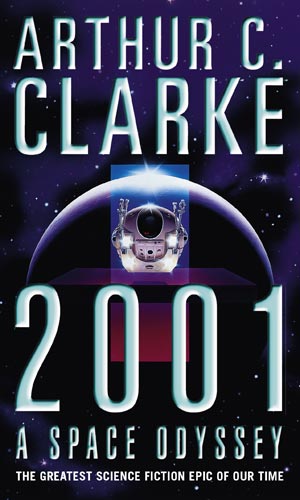
2001: A Space Odyssey - Review


Title: 2001: A Space Odyssey
Author: Arthur C. Clarke
First Published: New American Library (1 April 1968)
Genre: Science Fiction
Where to buy: AmazonWaterstonesBook Depository

 Having seen the film of 2001 a decided to read the book to see what is essentially the same story although portrayed in a different way.

So naturally the whole book is rather overshadowed by the question "what's it like compared to the film?" Well the trouble with that question is that film and literature are tow very different mediums. Film is the visual art and books are the written art. So I would probably question "Is it better than the film?" And I would have to say...no, it is not.

Alot of people find the film incredibly confusing and annoying (I personally think it's fascinating and very interesting) and therefore they assume the book will explain things more clearly. And it would be unfair to say it doesn't go into more detail than the film, although in my opinion it goes into too much detail.

Arthur C.Clarke was a big science geek and as such tends to explain every single piece of equipment on the ship. I'm all for background detail but there's a limit to how much excitement I can have reading how the spin of the carousel of the Discovery spaceship could be stopped when necessary and that when this happened it's angular movement had to be stored in a fly-wheel and switched back again when the rotation was re-started. After pages and pages of that kind of stuff it goes get a little tedious.

But there is plot interspersed among the technobabble and there it really does hit it's stride. The scenes later in the book with HAL are wonderfully atmospheric and give you a genuine feeling of Dave Bowman's feelings and emotions when he's in a very chilling and disturbing situation.

But then that get's halted constantly for another bit of science-talk. He builds and builds and build the tension and then cuts it of to talk about how scientists have thought that the rings of Saturn are estimated to be 3 million years old. This stopping and starting jolts you and makes you feel like you are starting to get somewhere and then smacked in the face with a physics lesson.

Also, the ending didn't make much more sense in the book. Not because I didn't understand the processes going on but the way it was written was hard to follow. Was he in space? Or on a planet? Or zooming through a tunnel? And then heading to a sun but then seeing things in the sun and then buzzing over again or...something?

So in conclusion. Like Great Gatsby it's not a truly awful book but I felt long sections were very long, boring and tedious and the good bits were too far and few in-between the long essays about astro-physics.